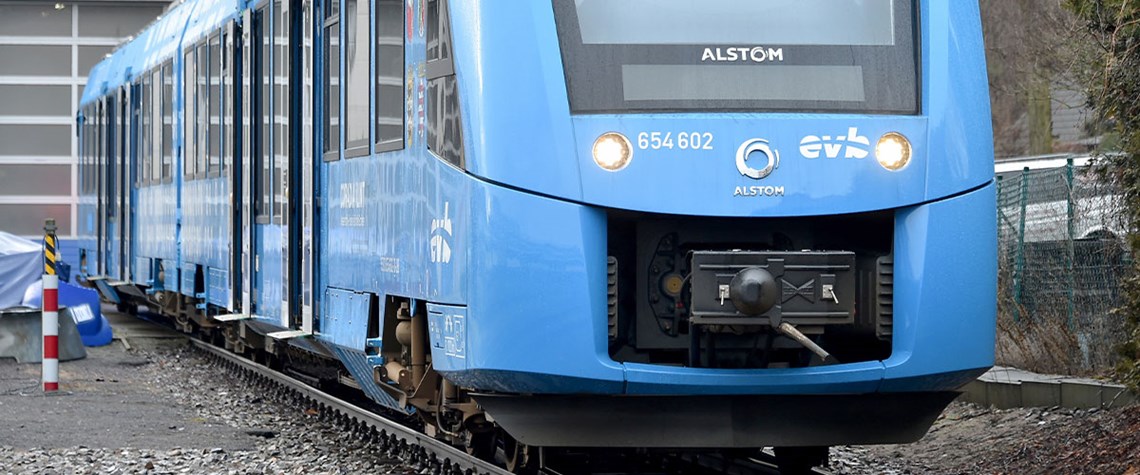
Alstom’s Coradia iLint trains were trialled on the network for two years
Hydrogen trains start running in Germany
15 incumbent diesel trains on route in Lower Saxony replaced with 14 hydrogen-powered passenger trains
Germany’s first 100pc hydrogen-powered train route has begun operation in Lower Saxony. The 15 incumbent diesel trains on the route are to be replaced with 14 hydrogen-powered Coradia iLint passenger trains, each able to run for 1,000 km on a single refuel. The trains belong to public transport authority LNVG and were designed by technology firm Alstom. “We are very proud to bring this technology into series operation as part of a world premiere, together with our great partners,” says Henri Poupart-Lafarge, CEO of Alstom. The technology uses a hydrogen fuel cell to produce electrical power for traction, allowing the trains to run on non- or partially-electrified lines. “Linde is commi

Also in this section
9 March 2026
Hydrogen has not stalled in the UK because the technology does not work. The problem is that the system around it does not yet move at the speed required
4 March 2026
Turmoil in Middle East reminds nascent clean hydrogen sector that its future prospects are dependent on global energy markets and geopolitics
25 February 2026
Low-carbon hydrogen and ammonia development is advancing much more slowly and unevenly than once expected, with high costs and policy uncertainty thinning investment. Meanwhile, surging energy demand is reinforcing the role of natural gas and LNG as the backbone of the global energy system, panellists at LNG2026 said
18 February 2026
Norwegian energy company has dropped a major hydrogen project and paused its CCS expansion plans as demand fails to materialise