Newsletters | Request Trial | Log in | Advertise | Digital Issue   |   Search
  • CCUS
  • Cap & Trade Markets
  • Voluntary Markets & Offsets
  • Corporate & Finance
  • Net Zero Strategies
  • Podcasts
Search
Related Articles
Shell delivers first cargo under Giignl green LNG rules
Cargo shipped from Gorgon project to Taiwan is first to verify GHG-neutral status using guidelines set by International Group of Liquefied Natural Gas Importers
Voluntary market set to embrace removals
Carbon-removal technologies to gain market share as companies fret over quality of credits generated by avoidance projects, according to Shell and BCG
Outlook 2023: Making net-zero aviation possible
Sustainable fuels will be a key solution to reaching a 1.5°C aligned path for aviation
Shell to test new CCS technology
Tests will be carried on industrial flue-gas sources from Equinor’s refinery at Mongstad
SAF ‘most viable solution’ for aviation in short term – Shell
The oil major aims to scale up SAF production to help the aviation industry decarbonise
Global carbon emissions set to rise in 2022 – IEA
World on course for 33.8bn t of CO₂ emissions this year, but major deployments of renewables and EVs have slowed rate of increase
International aviation agrees net-zero goal
Sector now covered by long-term target for first time, but criticism remains over how it is to be achieved
Energy transition a ‘massively complex’ challenge – van Beurden
Shift to clean energy will take decades, but Shell has the skills to make it happen, outgoing CEO says
Shell and Mitsui partner on Asian CCS
The firms will explore technical and commercial feasibility of CCS projects in Asia-Pacific, as well as options for shipping CO₂
Charting the global energy landscape to 2050: Sustainable fuels
Sustainable fuels can provide GHG reductions comparable to battery-electric vehicles and are applicable in multiple sectors, according to McKinsey
Shell aims to scale up SAF production capacity
Shell Aviation
Polly Martin
24 November 2022
Follow @PetroleumEcon
Forward article link
Share PDF with colleagues

SAF ‘most viable solution’ for aviation in short term – Shell

The oil major aims to scale up SAF production to help the aviation industry decarbonise

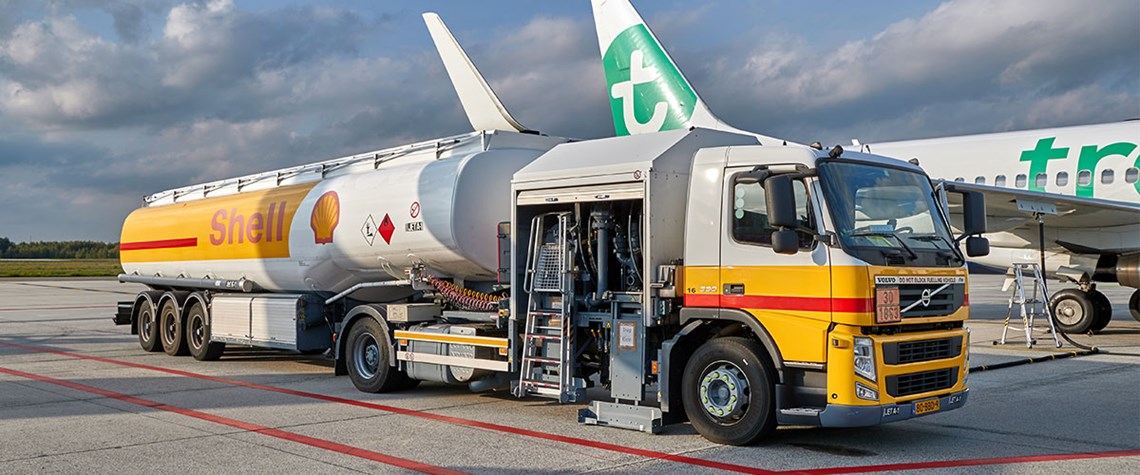
Aviation is cited as one of the hard-to-abate sectors, where options for reducing emissions remain limited. Transition Economist spoke to Jan Toschka, president of Shell Aviation, to discuss the major’s strategy amid increasing industry and government momentum to decarbonise the sector. What are some of the key challenges to developing ‘zero carbon’ aviation technology? Are certain technologies more suited for domestic versus long-haul flights? Toschka: To meet net-zero emissions in aviation, we need to explore every avenue available to us. At Shell, this involves supporting innovative R&D that helps develop new aviation solutions. In the future, new technologies such as electric-powered

Also in this section
Letter on carbon: Has the EU ETS come of age?
28 November 2025
The launch of the bloc’s emissions trading system in 2005 was a pioneering step, but as the scheme hits 21 its impact as a driver of decarbonisation is still open to debate
Can Oxy’s integrated CO₂ approach set a new benchmark for transition-era oil companies?
18 November 2025
Vicki Hollub, president and CEO of Occidental, has been selected as the 2026 recipient of the Dewhurst Award, the highest honour bestowed by WPC Energy. The Dewhurst Award celebrates exceptional leadership, groundbreaking innovation and a lifetime of significant achievements in sup-port of the development and advancement of the energy industry.
Letter from London: Show me the carbon
11 November 2025
Transition policies must recognise that significant industrial demand for carbon will continue even as economies hit net zero
Letter from Europe: Western retreat raises doubts over climate leadership
Opinion
6 November 2025
After years of pursuing ideologically driven climate leadership, Western powers are now stepping back under mounting political pressure and rising populist opposition—prompting concern essential climate action could be sidelined

Share PDF with colleagues

COPYRIGHT NOTICE: PDF sharing is permitted internally for Petroleum Economist Gold Members only. Usage of this PDF is restricted by <%= If(IsLoggedIn, User.CompanyName, "")%>’s agreement with Petroleum Economist – exceeding the terms of your licence by forwarding outside of the company or placing on any external network is considered a breach of copyright. Such instances are punishable by fines of up to US$1,500 per infringement
Send

Forward article Link

Send
Sign Up For Our Newsletter
Project Data
Maps
Podcasts
Social Links
Featured Video
Home
  • About us
  • Subscribe
  • Reaching your audience
  • PE Store
  • Terms and conditions
  • Contact us
  • Privacy statement
  • Cookies
  • Sitemap
All material subject to strictly enforced copyright laws © 2025 The Petroleum Economist Ltd
Cookie Settings
;

Search