


Newsletters | Request Trial | Log in | Advertise | Digital Issue   |   Search
  • Upstream
  • Midstream & Downstream
  • Gas & LNG
  • Trading & Markets
  • Corporate & Finance
  • Geopolitics
  • Podcasts
Search
Related Articles
Sasol delays South Africa’s ‘gas cliff’
The company will use methane-rich gas produced from local coal to temporarily replace lost supplies from Mozambique
Hydrocarbon Processing Refining Databook 2025: Middle East & Africa
The Middle East is focusing on modernisation and expansion projects, while Africa is seeking to reduce its imports of refined products
Outlook 2025: The importance of ensuring a just transition for developing nations
While the global energy transition is essential for reaching net zero, it is equally important that less-developed countries are allowed to realise the benefits of their hydrocarbon resources
Moscow’s moves may impede Africa’s energy ambitions
Upstream projects may not benefit from Russia’s involvement, but South Africa might be seeking to become an importer of Russian molecules
Majors pull out of flagship South African gas projects
Without a pipeline of developments in place, the country’s energy crisis is poised to worsen
Namibia’s success boosts other frontiers
Exploration efforts are increasingly spreading into South African and even South American waters
Karpowership charts unique course
The floating power station specialist discusses its plans in South Africa and elsewhere
Rise of Brics challenges oil world order
The five economies are shaking up global markets, and they could be on the cusp of a major break from the existing order
Can gas solve South Africa’s power crisis?
Domestic production and LNG imports are on the table as the country seeks to restore energy security
Eco Atlantic sees promise on the frontiers
The independent tells Petroleum Economist it sees further opportunities in Guyana, South Africa and Namibia
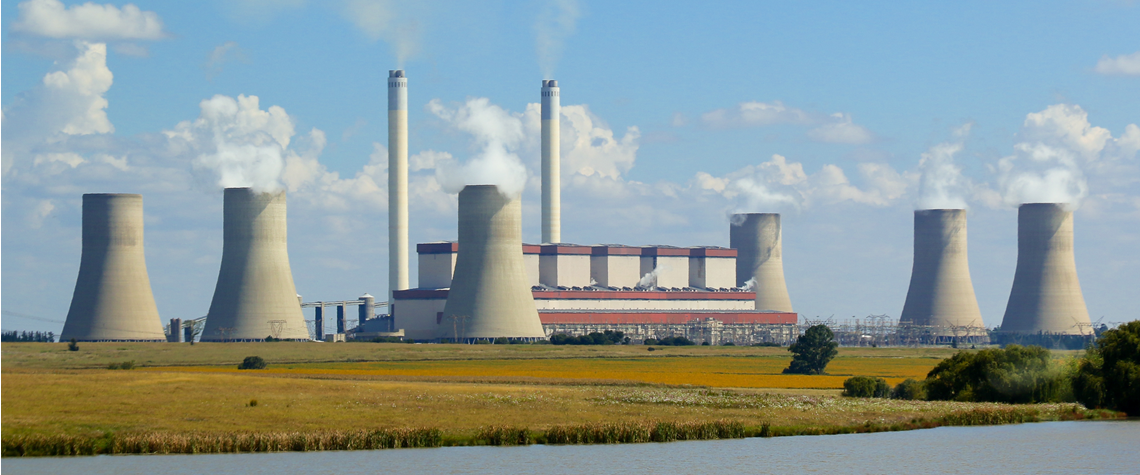
Power Station near Standerton in the Mpumalanga province of South Africa
South Africa
Alastair O’Dell
Senior Editor
14 November 2019
Follow @PetroleumEcon
Forward article link
Share PDF with colleagues

South Africa eyes industrial boost through IRP

Energy minister Gwede Mantashe outlines the benefits expected from the country’s Integrated Resource Plan (IRP) 2019 beyond energy security

The South African government is seeking a range of benefits from its IRP 2019—including industrial development, self-sufficiency and regional co-operation—in addition to its core aims, according to minister of minerals resources and energy Gwede Mantashe on the sidelines of the Africa Oil Week conference in Cape Town.  South Africa updated its electricity supply blueprint in mid-October with the cabinet-approved IRP, which sets out its preferred generation mix to meet expected electricity demand to 2030. The IRP’s purpose is to reconcile its three aims of ensuring energy security, minimising costs and meeting environmental commitments.  While the future of gas production in Africa “looks pos

Also in this section
Indian refiners prove their adaptability
23 January 2026
A strategic pivot away from Russian crude in recent weeks tees up the possibility of improved US-India trade relations
Gas deal keeps Lebanon’s offshore hopes alive
23 January 2026
The signing of a deal with a TotalEnergies-led consortium to explore for gas in a block adjoining Israel’s maritime area may breathe new life into the country’s gas ambitions
Letter from Saudi Arabia: Big oil meets big shovel
Opinion
22 January 2026
As Saudi Arabia pushes mining as a new pillar of its economy, Saudi Aramco is positioning itself at the intersection of hydrocarbons, minerals and industrial policy
Turkey locks in more Azeri gas
22 January 2026
New long-term deal is latest addition to country’s rapidly evolving supply portfolio as it eyes role as regional gas hub

Share PDF with colleagues

COPYRIGHT NOTICE: PDF sharing is permitted internally for Petroleum Economist Gold Members only. Usage of this PDF is restricted by <%= If(IsLoggedIn, User.CompanyName, "")%>’s agreement with Petroleum Economist – exceeding the terms of your licence by forwarding outside of the company or placing on any external network is considered a breach of copyright. Such instances are punishable by fines of up to US$1,500 per infringement
Send

Forward article Link

Send
Sign Up For Our Newsletter
Project Data
Maps
Podcasts
Social Links
Featured Video
Home
  • About us
  • Subscribe
  • Reaching your audience
  • PE Store
  • Terms and conditions
  • Contact us
  • Privacy statement
  • Cookies
  • Sitemap
All material subject to strictly enforced copyright laws © 2025 The Petroleum Economist Ltd
Cookie Settings
;

Search
