


Newsletters | Request Trial | Log in | Advertise | Digital Issue   |   Search
  • Upstream
  • Midstream & Downstream
  • Gas & LNG
  • Trading & Markets
  • Corporate & Finance
  • Geopolitics
  • Podcasts
Search
Related Articles
Indian refiners prove their adaptability
A strategic pivot away from Russian crude in recent weeks tees up the possibility of improved US-India trade relations
India’s refining project strengthens ties to Mongolia
The Central Asian country’s first oil refinery is being funded by a $1.7b line of credit from New Delhi, but routes in and out of the country remain controlled by Russia and China
Letter from London: Oil’s golden triangle
The interplay between OPEC+, China and the US will define oil markets throughout 2026
The curious case of oil-on-water
The market is facing being drowned in excess crude, but one caveat is that a large chunk is due to buyers reluctant to snap up sanctioned barrels
Turkmenistan's pipe dream
Construction of the pipeline in Afghanistan is making tangible progress, but extending it into Pakistan and India remains unrealistic for political reasons
China’s oil plan comes together
The country’s rapid output growth is an example that other producers could learn from
China seizes oil security opportunity
A combination of geopolitical uncertainty and OPEC+ barrels has driven a renewed focus on building strategic oil stocks despite flagging demand
Arctic LNG comes in from the cold
Beijing now appears prepared to accept discounted Russian LNG, even at the cost of heightened sanctions risk
India’s LNG falling short
More needs to be done to meet the government’s ambitious targets for gas
China’s role as oil buffer stock manager
The country’s intervention in global oil markets to stabilise prices could last well into 2026
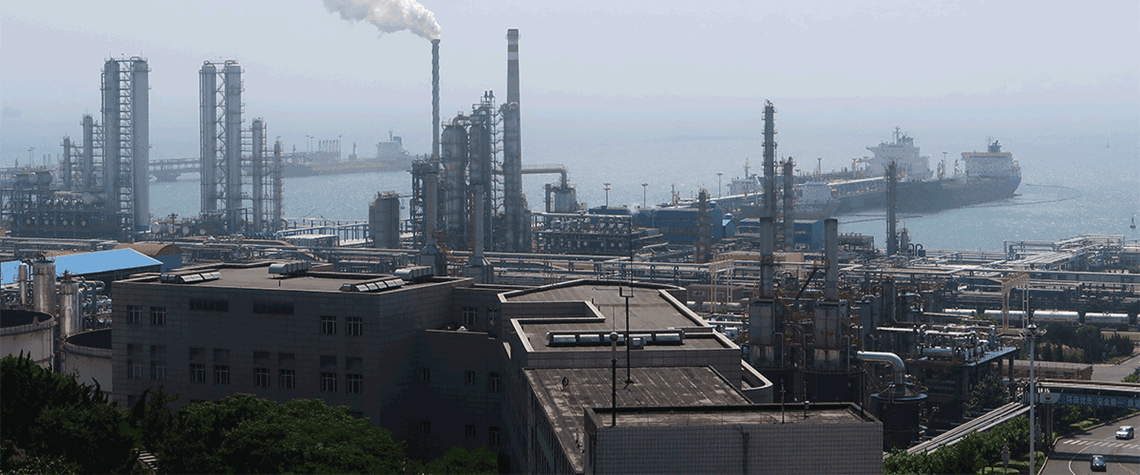
CNPC's Dalian Petrochemical Corp refinery
India China
Lee Nichols,
Vice-president, content,
Gulf Energy Information
13 November 2023
Follow @PetroleumEcon
Forward article link
Share PDF with colleagues

Petchems Report: Asia ramps up petchems production

India and China are both looking to substantially boost their petchems capacities out to 2030

The Asia-Pacific region has and will continue to be the leader in petrochemical capacity additions. Over the next several years, the region will add a substantial amount of new capacity. Ethylene capacity is forecast to increase by approximately 110mt/yr, to more than 320mt/yr. Polyethylene capacity will increase by nearly 25mt/yr, while propylene and polypropylene capacity are forecast to rise by nearly 40mt/yr and more than 43mt/yr, respectively. The region will also add a significant amount of intermediate and specialty chemicals and petrochemicals capacity. The GEI database is tracking more than 220 active petrochemical projects in Asia-Pacific. Most of these additions will be in China a

Also in this section
Indian refiners prove their adaptability
23 January 2026
A strategic pivot away from Russian crude in recent weeks tees up the possibility of improved US-India trade relations
Gas deal keeps Lebanon’s offshore hopes alive
23 January 2026
The signing of a deal with a TotalEnergies-led consortium to explore for gas in a block adjoining Israel’s maritime area may breathe new life into the country’s gas ambitions
Letter from Saudi Arabia: Big oil meets big shovel
Opinion
22 January 2026
As Saudi Arabia pushes mining as a new pillar of its economy, Saudi Aramco is positioning itself at the intersection of hydrocarbons, minerals and industrial policy
Turkey locks in more Azeri gas
22 January 2026
New long-term deal is latest addition to country’s rapidly evolving supply portfolio as it eyes role as regional gas hub

Share PDF with colleagues

COPYRIGHT NOTICE: PDF sharing is permitted internally for Petroleum Economist Gold Members only. Usage of this PDF is restricted by <%= If(IsLoggedIn, User.CompanyName, "")%>’s agreement with Petroleum Economist – exceeding the terms of your licence by forwarding outside of the company or placing on any external network is considered a breach of copyright. Such instances are punishable by fines of up to US$1,500 per infringement
Send

Forward article Link

Send
Sign Up For Our Newsletter
Project Data
Maps
Podcasts
Social Links
Featured Video
Home
  • About us
  • Subscribe
  • Reaching your audience
  • PE Store
  • Terms and conditions
  • Contact us
  • Privacy statement
  • Cookies
  • Sitemap
All material subject to strictly enforced copyright laws © 2025 The Petroleum Economist Ltd
Cookie Settings
;

Search
