


Newsletters | Request Trial | Log in | Advertise | Digital Issue   |   Search
  • Upstream
  • Midstream & Downstream
  • Gas & LNG
  • Trading & Markets
  • Corporate & Finance
  • Geopolitics
  • Podcasts
Search
Related Articles
OPEC presses pause
The group’s oil production declined in November, our latest analysis finds, amid divided sentiment over market balances and geopolitical jitters
Learning from oil’s supercycle miss
Mistaken assumptions around an oil bull run that never happened are a warning over the talk of a supply glut
Letter from London: Oil’s golden triangle
The interplay between OPEC+, China and the US will define oil markets throughout 2026
The complex crude glut picture
The swelling crude supply story involves the key plot twists of reluctant buyers, limited oil stocks and refiners playing the long game
Alberta’s energy hub sees silver lining
US tariffs bolster Alberta’s Industrial Heartland exports to Asia
The curious case of oil-on-water
The market is facing being drowned in excess crude, but one caveat is that a large chunk is due to buyers reluctant to snap up sanctioned barrels
OPEC+ nears output targets amid unsolved riddles
OPEC+ has proven to be astute at bringing back oil production, but mysteries around Chinese buying, missing barrels and oil-on-water have left the group in wait-and-see mode
Nigeria charts ‘just transition’ course for NOCs
OPEC Governor Ademola Adeyemi Bero argues that only by prioritising oil and gas through partnerships with IOCs and stable OPEC market management can NOCs fulfil their pivotal global role
Oil’s fragile AI trillions
Prices risk hitting $10/bl should the tech bubble burst amid worrying economic fallout
OPEC+ exposes its producers’ limits
Saudi Arabia, the UAE and Iraq appear to be only members able to increase output as Russia approaches close to maximum capacity
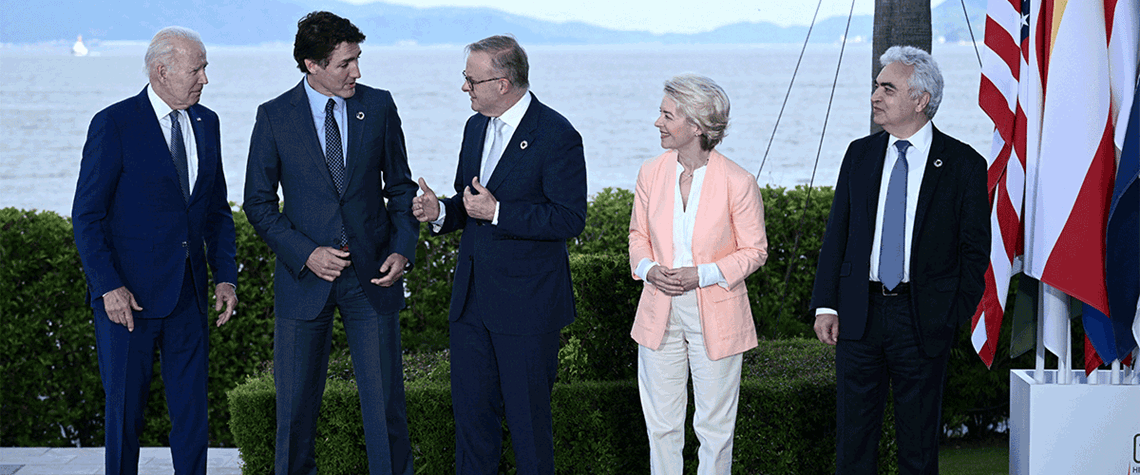
IEA executive director Fatih Birol, far right, at the G7 meeting in May with, from left, US president Joe Biden, Canadian prime minister Justin Trudeau, Australian prime minister Anthony Albanese, and European Commission president Ursula von der Leyen
Markets
Neil Atkinson
2 June 2023
Follow @PetroleumEcon
Forward article link
Share PDF with colleagues

IEA highlights energy divergence as milestone 50th nears

Energy body punches above its weight as it provides direction amid crossroads

The IEA will celebrate its 50th birthday in late 2024. The agency was born out of the energy crisis caused by the October 1973 Yom Kippur War, which led leading oil producers to suspend sales to major consumers. This, plus price increases announced by Opec, ushered in a period of stagflation and economic turmoil. In 1972, the price of Dubai crude (Brent had not been invented back then) averaged $1.90/bl. In 1974, it averaged $10.41/bl. In the ten years before the Yom Kippur War, global inflation averaged 3.6pc/yr; in the ten years afterwards—which included another major price spike in the aftermath of the Iranian Revolution and the Iran-Iraq war—it averaged 11.6pc. Industrialised countries,

Also in this section
Canada’s Asian pivot faces hurdles
12 December 2025
The federal government is working with Alberta to improve the country’s access to Asian markets and reduce dependence on the US, but there are challenges to their plans
New Zealand is back open for business
11 December 2025
The removal of the ban on oil and gas exploration and an overhaul of the system sends all the right messages for energy security, affordability and sustainability
New Zealand’s gas horror story will haunt for years to come
10 December 2025
The economic and environmental cost of the seven-year exploration ban will be felt long after its removal
OPEC presses pause
9 December 2025
The group’s oil production declined in November, our latest analysis finds, amid divided sentiment over market balances and geopolitical jitters

Share PDF with colleagues

COPYRIGHT NOTICE: PDF sharing is permitted internally for Petroleum Economist Gold Members only. Usage of this PDF is restricted by <%= If(IsLoggedIn, User.CompanyName, "")%>’s agreement with Petroleum Economist – exceeding the terms of your licence by forwarding outside of the company or placing on any external network is considered a breach of copyright. Such instances are punishable by fines of up to US$1,500 per infringement
Send

Forward article Link

Send
Sign Up For Our Newsletter
Project Data
Maps
Podcasts
Social Links
Featured Video
Home
  • About us
  • Subscribe
  • Reaching your audience
  • PE Store
  • Terms and conditions
  • Contact us
  • Privacy statement
  • Cookies
  • Sitemap
All material subject to strictly enforced copyright laws © 2025 The Petroleum Economist Ltd
Cookie Settings
;

Search
